
'Nehru's hegemonic politics has been responsible for many ills, which undoubtedly includes Kashmir'
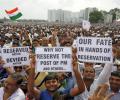
'Where should shudra-OBCs go because of whom the nation is surviving?'

Farm loan waivers should not be regarded as expenditure but as incentive and investment, argues B S Raghavan, the distinguished civil servant.

Why has Mumbai's cyber police taken no action against these WhatsApp groups who everyday, commit offences under the Indian Penal Code? The police cannot be unaware of their existence, observes Shruthi Marathe.

'A class antagonism of rich versus poor took the colouring of a communal confrontation,' says Sunil Sethi.

The Gomti Riverfront Development project, the Agra-Lucknow Expressway, the Jai Prakash Narayan International Centre and the efforts towards the beautification of Old Lucknow are some of Akhilesh Yadav's initiatives that are the subject of investigation.

Sensex hit a record high of 27,225.85 and Nifty hit a record high of 8,141.90 in the intra-day trades today.

Academicians Lloyd and Susanne Rudolph, who were on Monday presented with Padma Bhushan award, predict significant changes in Indian politics if Aam Aadmi Party performs well in the Lok Sabha elections.
The jobless armies of youthful India are getting angrier and desperate, warns Shekhar Gupta.

'Disparity is not only in Mumbai; you see it in every city. The other day, I saw right next to the mansion of Mukesh Ambani worth Rs 5,000 crore for one family, thousands of people sleeping on the pavement. This is the urban India you have created!'

'Creativity and invention come from engaging with the physical world.' 'This is something that we in the upper classes of India do not do as much as the rest of the world,' says Aakar Patel.

For the first time the Ford Foundation is placed under a watch.
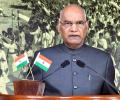
In his first address to the nation, on the eve of 71st Independence Day, President Ram Nath Kovind hailed the government's demonetisation and GST decision.

Prime Minister Narendra Modi who inducted 19 new ministers into his Cabinet on Tuesday has carried out major changes in the portfolios of his top ministers.

'There is no difference morally between politicians scoring points amid the rubble and non-politicians who assume that politics and corruption necessarily had something to do with it,' says Mihir S Sharma. 'Both are twisting a tragedy to their own ends.'
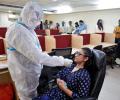
In another 2-3 weeks, coronavirus will chariot India to overtake the United States. In March, Modi had exhorted the nation to celebrate India's impending success over the virus by clanging metal plates. Make no mistake, India is losing this momentous war under his captaincy, notes Ambassador M K Bhadrakumar.

'Sexual violence against women is not something unique to India but in our parts the victim must also have to contend with other burdens. Such as the notion of 'honour' and its loss,' says Aakar Patel.

Butterflies aren't just easy on the eyes. Their presence in a place indicates the relative health of the environment.

For more than half of all Indian households, the very personal act of defecation is an open affair, says Joel Rai

The Wuhan meetings signify an incremental shift in China's position on India as well as each country buying time for the next phase of bilateral relations, says Srikanth Kondapalli.
.gif)
Rakeysh Omprakash Mehra's latest film lacks clarity and coherence.

Permissive communalism, as represented by the Sachar Committee report, cannot become the basis to counter the threat of majoritarianism, says D L Sheth.
For this dispensation, ideas are dangerous. Those who propagate liberalism and democratic traditions are even more dangerous, observes Rashme Sehgal.

There are many firsts in Prime Minister Narendra Modi's Lok Sabha speech which constitute the cardinal elements of a strategy which has all the potential to serve as the mainspring of the polity for the rest of the century, says B S Raghavan.

Since many of Modi's urban policies were initiated in Ahmedabad, the city may act as a template to examine what can be expected in a country that is witnessing the biggest migration from rural to urban areas in the world

'He is wily and has everything that a political leader needs to succeed at that level.' 'He would be outstanding as a counter to Modi in the Lok Sabha, if he had the Opposition benches behind him,' says Aakar Patel.
'The economy is in a free fall.'
'And it's been declining for so long, so consistently, that the promise of growth and better days now looks a fantasy.' 'A mid-1970s kind of pessimism, even hopelessness, is growing among the young.' 'This isn't what Mr Modi promised them.' 'Their aspirations and needs are clear and present, and not being fulfilled,' notes Shekhar Gupta.
The Planning Commission has not been central to the policy making process since the mid-1960s, says Nitin Desai.

Among the most deprived communities in India live and work under asbestos roofs. The National Institute for Health and Family Welfare estimates exposure to asbestos has resulted in higher incidence of cancer among those living under asbestos roofs, points out Gopal Krishna.

'In a future where newspapers are gone, the public will have a severe lack of material to be properly informed.' 'We will be left in a world of journalism that is entirely populated by Arnab and anchors like him, competing on the basis of passion and anger, and by people who pull out their phone and tweet a comment without first hand information,' says Aakar Patel.

The challenges authorities face in cleaning Ganga and other holy rivers in Varanasi.

'Embedded with the divisive regime, they administer heavy doses of the opium of religion and nationalism day in and day out,' observes Mohammad Sajjad.

Both India and South Korea will use President Park Geun-hye's visit to unveil a comprehensive programme for mutual benefit and impacting on regional security environment, says Srikanth Kondapalli.
'When Hindus converted through inducements there was no hue and cry, but when reconversions took place, everyone cried foul. If re-conversions are bad, so are conversions.' 'Our government is not getting involved either in conversions or re-conversions. The BJP has nothing to do with it.' Parliamentary Affairs Minister M Venkaiah Naidu in a candid interview.

'Modi should not feel shy of proclaiming as the meaning of secularism regard for all religions in proportion to their numbers in tune with the spirit of democracy and adopting it as State policy,' says B S Raghavan.

'Modi, focused on youth and their aspirations, has articulated a truly disruptive change: One of hope, of duties rather than rights, of standing up to the world instead of being bullied by it,' says Rajeev Srinivasan.
However, independent economists are not as gung-ho as the finance ministry over the likelihood of deficit target being met this time around, says Indivjal Dhasmana.
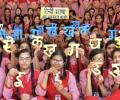
Flowing from an inadequate understanding of Tamil history and politics is an urban elitist mindset that does not seem to be able to touch and feel the real angst of the larger Tamil-speaking masses, cutting across the social and economic status of the individual, says N Sathiya Moorthy.

'Indian politics has had three-and-a-half master narratives -- secular nationalism, Hindu nationalism, justice for lower castes and regionalism. The AAP seeks to go beyond that. Therein lies its promise and its challenge,' says Ashutosh Varshney, Brown University professor and author of book Battles Half Won, India's Improbable Democracy.
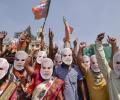
'You've got to be a doer to be re-elected.' 'You don't have to be a great communicator or an orator any more because voters want to see action and development on the ground.' 'And they want a doer rather than just an orator.'
 © 2026 Rediff.com - Advertise with us - Disclaimer - Privacy Policy - Sitemap - Feedback - About us - Terms of use - Grievances